Five ways the thinking becomes a proposition.
These are illustrative engagement shapes, not client case studies. They show the type of strategic work Syntropy structures — sanitized of identifying details, financial figures, and proprietary data. Each one represents a different way an idea was turned into a decision-ready proposition.
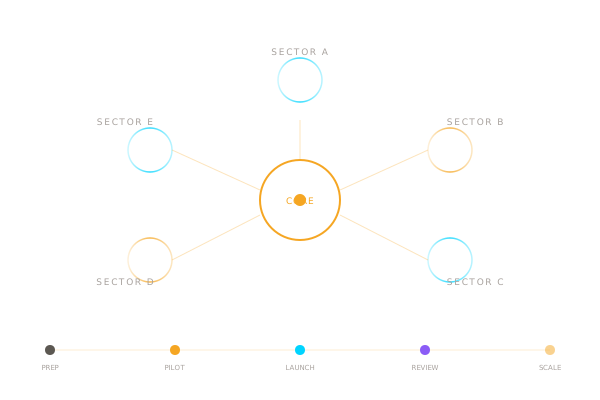
Strategic growth architecture.
The question: A technology platform held validated IP across multiple sectors but lacked a commercialization pathway. How do you turn latent IP into a portfolio of ventures without overcommitting capital or surrendering control?
The framework: A hub-and-spoke model where the platform provides technology, mentorship, and IP governance, while a low-risk commercialization layer (early-stage entrepreneurs) tests market demand across five sectors in parallel. A phased 12-month pilot — preparation, approval, engagement, launch, review — generates data before each commitment.
The outcome category: A structured pilot authorization with a risk-mitigated, royalty-based engagement model and a clear scaling pathway. The client retained full IP control while creating a pipeline of future partners.
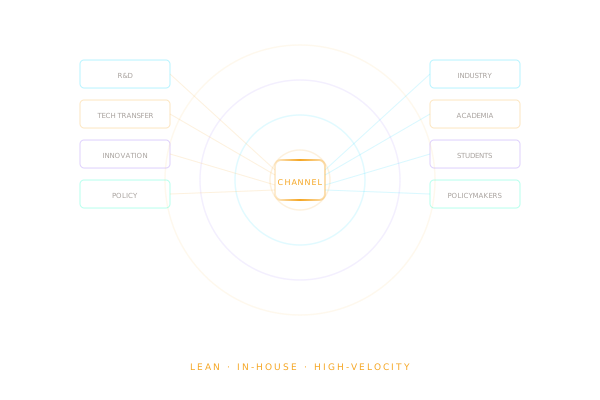
Thought-leadership media strategy.
The question: A national R&D organization had deep technical credibility but no public voice. How do you build visibility and industry trust without a large marketing budget or a dedicated media team?
The framework: A lean YouTube channel strategy — podcast and panel-discussion format, with leadership interviews and academic collaborations. Content pillars (R&D breakthroughs, technology transfer, innovation stories) feed the channel; audience segments (industry, academia, students, policymakers) receive it. Execution uses an in-house studio, a single content editor, and leadership as on-air talent — minimal external cost.
The outcome category: A cost-efficient, self-sustaining media asset positioned as a long-term digital platform, launched alongside a flagship event for maximum initial visibility.
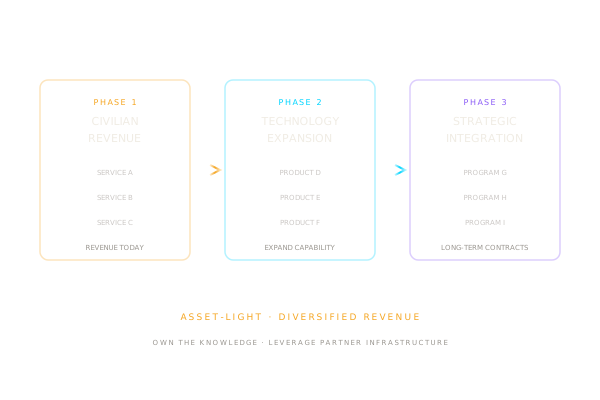
Technology platform business plan.
The question: An advanced materials initiative needed a business plan that could attract investment without requiring heavy capital expenditure. How do you build a strategic manufacturing capability on an asset-light model?
The framework: A three-phase execution strategy — Phase 1 builds civilian revenue through services (3D printing, testing, prototypes); Phase 2 expands into technology products (compounds, modified materials); Phase 3 integrates into strategic sectors with long-term contracts. The platform owns knowledge, quality, and customer relationships while leveraging partner infrastructure for production.
The outcome category: A diversified revenue model (products + services + strategic programs) that reduces business risk, with a clear investment thesis and a phased path from commercial revenue to strategic capability.
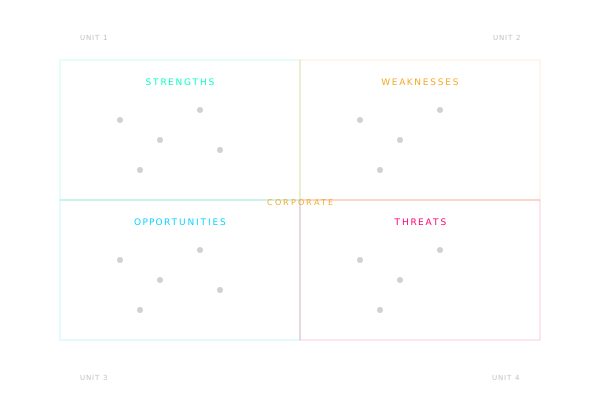
Corporate business development plan.
The question: A public-sector commercial entity with multiple business units needed a consolidated growth strategy. How do you stabilize existing units while building new revenue streams across diverse market segments?
The framework: A SWOT-grounded strategy that addresses each business unit individually — capacity expansion for some, market penetration for others, and diversification through new services. Austerity measures and operational efficiency fund the growth pipeline. Short-term goals (stabilization, distribution, promotion) feed long-term goals (accreditation, technology parks, one-window operations).
The outcome category: A prioritized action plan with immediate, short-term, and long-term horizons, plus a projected revenue trajectory and a clear governance structure for execution.
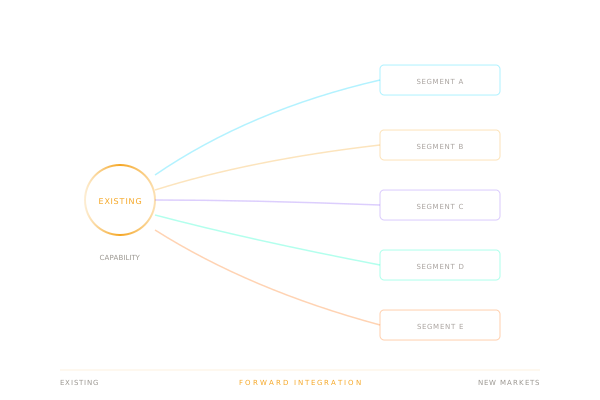
Market expansion strategy.
The question: A radiation-processing service had a strong existing capability but was underutilizing its capacity. How do you expand into adjacent market segments without losing focus on the core?
The framework: A forward-integration strategy that maps five opportunistic segments — each with its own market development tactics, influencer engagement plan, and regulatory pathway. Academic collaborations create R&D credibility; pressure groups and public awareness create demand pull; aggressive sales activities create market penetration. The core capability stays fixed; the segments diversify.
The outcome category: A segmented go-to-market plan with tactical execution steps for each segment, academic and regulatory partnerships structured, and a clear path from pilot samples to commercial contracts.
What these shapes have in common.
Five different engagements, one consistent method. Each started with a question that could not be answered with a template. Each required structure before presentation. Each delivered a framework the client could execute — not just a document they could file.
Question before answer
Every engagement began by clarifying the real decision the client faced — not the deliverable they initially asked for.
Framework before content
The strategic structure came first. The slides, numbers, and narratives followed the logic — not the other way around.
Phased before scaled
Each plan proposed a pilot before a programme. Data from the pilot justified the scale-up — never the reverse.
Risk before ambition
Every shape includes a risk-mitigation layer. Growth without downside protection is not a strategy — it is a bet.
Execution before elegance
The plans are buildable. The client can act on them the next morning — not admire them from a shelf.
Which shape is your idea?
These are five of the ways an engagement can start. Yours might be a sixth. The first conversation is always free, always honest, and always about the decision you actually face.